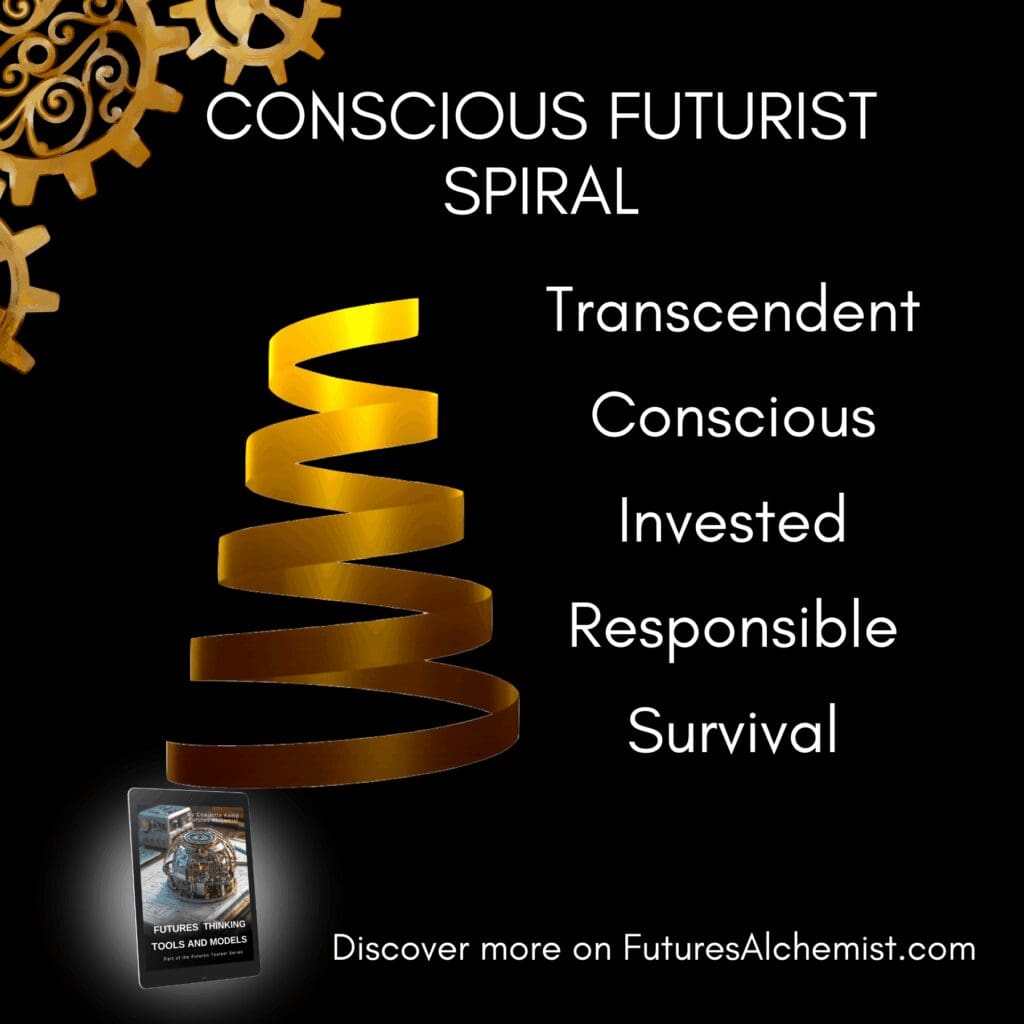
Definition
The Conscious Futurist Spiral is a mindset model that reflects how individuals grow and shift in their thinking about the future. Unlike staged models such as Maslow’s Hierarchy of Needs, which suggest a lock-step progression, the Spiral reflects a more realistic, dynamic journey, one of movement, slippage, re-alignment, and return.
It accepts that humans are complex, inconsistent, and constantly responding to their environment and internal state.
Rather than climbing a ladder or ascending stairs, we revolve through stages that we may revisit at different times or in different areas of our lives. The spiral allows for gradual progress, and offers a lens through which we can understand our own futures thinking — as well as that of our audiences, teams, or clients.
The Spiral has five rings or levels, each reflecting a broader time horizon and a widening circle of concern:
Survival
At the base is Survival. This is where all futures thinking begins — or ends — in a crisis. The pandemic made this real for many people, but any number of personal or systemic shocks (illness, loss, conflict, displacement) can pull us down to this level. Here, our timeline is short and our concern is narrow: immediate needs, safety, security.
We may not like the word “survival,” but it is honest. And honesty is the first act of consciousness. The most responsible thing you can do for the future is to survive the present crisis.
Responsible
As safety stabilises, we rise to Responsibility. Our attention expands to include others — our family, friends, colleagues, or team members. We begin thinking further ahead, perhaps to next month or quarter. Responsibility means shifting from reaction to intention, from victimhood to reclaiming agency. We begin planning again, rebuilding from crisis, and contributing to those within our immediate circle of care.
Invested
When we move into Invested thinking, we begin shaping the world beyond our direct circle. Our attention may focus on our business, industry, organisation, or cause. We take on influence, and that influence carries impact. Here, we extend time frames even further, perhaps to years. We also take responsibility for the ripple effects of our voice, decisions, and leadership in wider systems.
Conscious
The Conscious Futurist operates from a place of expanded awareness. Time horizons extend to decades. Concern stretches beyond personal legacy to include strangers, systems, future generations. We think in terms of policy, culture, and education. Our influence is not measured by visibility, but by depth. Ego takes a back seat. We are working for futures we may never personally see.
Transcendent
The highest level, Transcendence, reaches beyond personal or even generational vision. It is about legacy and transformation. The Transcendent Futurist builds for futures that may never return gratitude. They are motivated not by recognition but by deep values — reshaping cities, organisations, cultures, or ideas for long-term benefit. Their impact might be anonymous but deeply significant.
Why the Spiral Works
The Spiral is not fixed. We move up or down depending on circumstances. Crisis can see us slip down the spiral to return us to Survival. Illness or grief can contract our vision. This is normal for humans. But having touched higher levels, we know the way back. We remember who we’ve been, and we can reclaim that perspective.
This model is especially helpful for futurists, facilitators, coaches, and leaders to assess not just their own mindset, but to “read the room.” Speaking of long-range futures to someone stuck in Survival may create anxiety, not vision. If we are temporarily down at Survival or Responsible we may not be able to assist a visionary client who is at the Conscious level. Alignment matters. We must meet people where they are on the spiral if we hope to help them move forward.
The Conscious Futurist Spiral invites compassion, intentionality, and resilience, a model that mirrors the complexity of human growth in a turbulent world.
Origin
Charlotte Kemp, 2020
Other posts in this series