Introduction
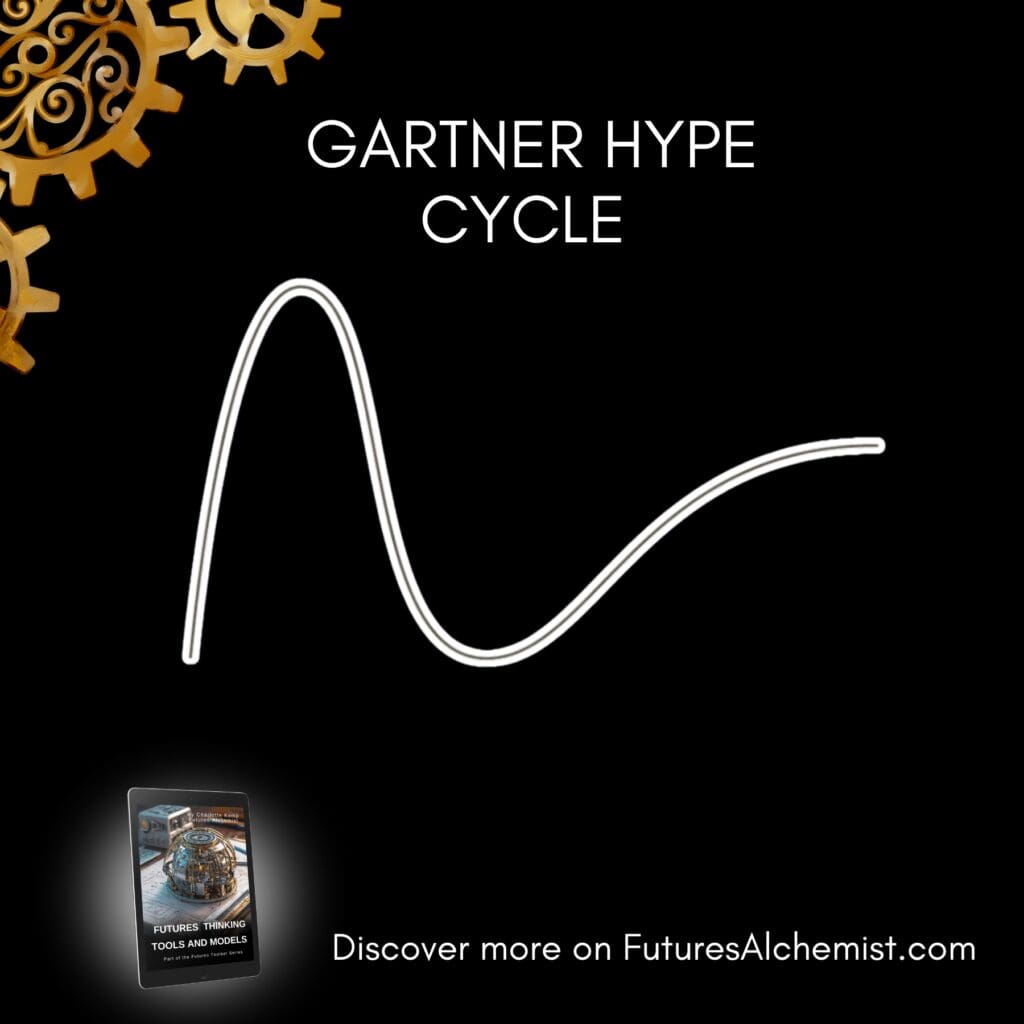
The Gartner Hype Cycle is a futures and innovation tool that describes the typical pattern of expectation, disappointment, and maturity that emerging technologies and innovations tend to follow over time.
Rather than tracking the actual capability of a technology, it tracks perception, hype and sentiment of the perceived value as a new idea moves from novelty to normality.
It is useful for creating a language to understand why some innovations are overestimated early on and then dismissed too soon.
What it looks like
The Hype Cycle is usually represented as a curve with five distinct stages:
- Innovation Trigger: A breakthrough, idea, or launch generates initial interest.
- Peak of Inflated Expectations: Attention surges. Expectations become exaggerated. Early success stories (and failures) dominate narratives.
- Trough of Disillusionment: Interest declines as reality fails to meet hype. Failures become more visible than successes.
- Slope of Enlightenment: More grounded understanding emerges. Practical use cases begin to develop.
- Plateau of Productivity: The technology becomes stable, useful, and widely adopted.
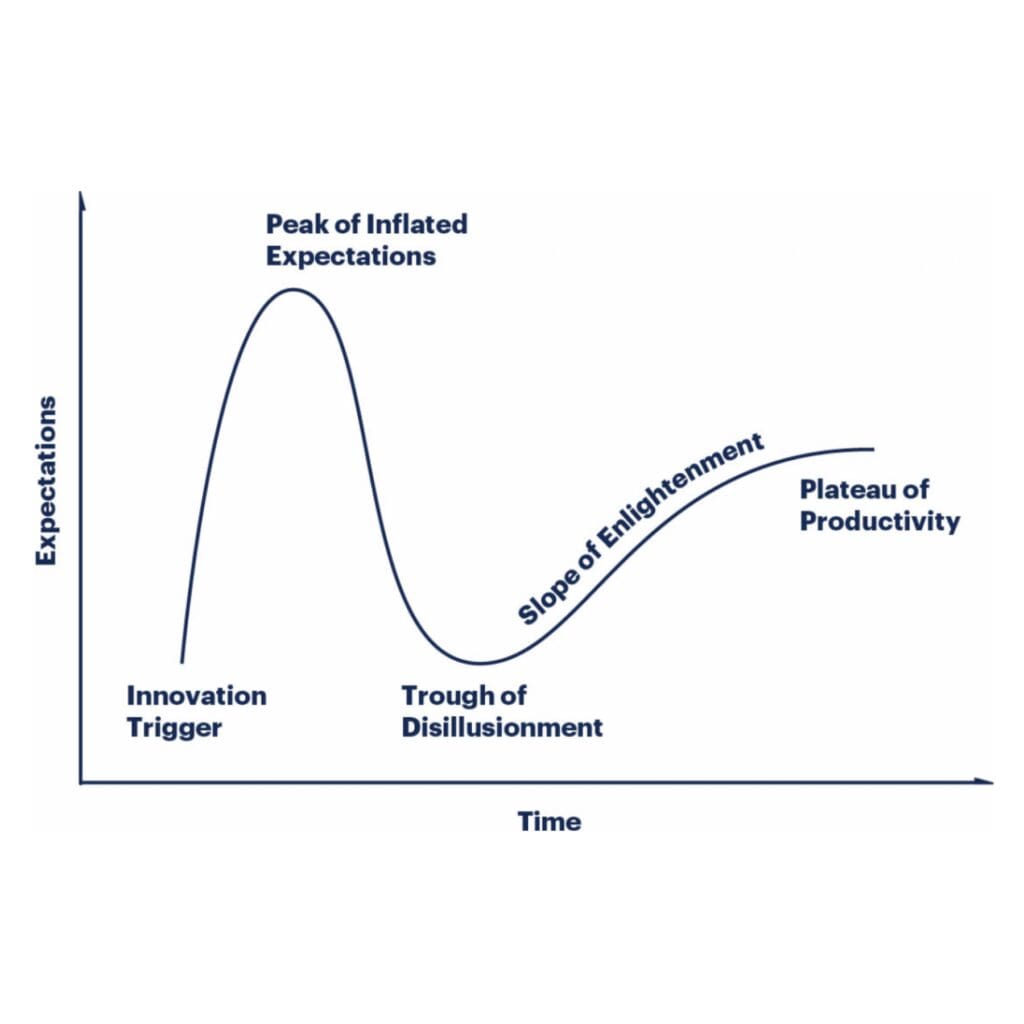
When used in practice, organisations can place technologies along the curve, tracking where they are perceived to be and exploring how that impacts investment decisions and strategy. It is essentially a sense-making tool.
Example
A widely cited example is the trajectory of blockchain technology and Bitcoin.
- Innovation Trigger: The publication of Bitcoin’s whitepaper and early adoption
- Peak of Inflated Expectations: Blockchain was heralded as a solution for everything—from finance to healthcare to voting systems
- Trough of Disillusionment: Projects failed, scalability issues emerged, and skepticism grew
- Slope of Enlightenment: More targeted applications developed (e.g. supply chain tracking, digital assets)
- Plateau of Productivity: Still evolving, but increasingly embedded in specific, practical use cases rather than universal transformation narratives
The key insight is not whether blockchain succeeded or failed, but how expectations shifted over time.
How and when it is used
The Hype Cycle is most useful when:
- Evaluating emerging technologies or innovations
- Deciding when to engage, invest, or wait
- Interpreting market narratives vs reality
It is particularly valuable in environments where media attention is intense or where trending topics are influential. It is useful when investment cycles are reactive and where FOMO (Fear of missing out) drives decision-making.
How it is used
- Expectation Management – Leaders use the Hype Cycle not just to assess technology but to manage internal expectations. As a communication tool it helps departments understand where a project is on the curve and to reframe the dip, or Trough of Disillusionment, as normal.
- Narrative Analysis – Some futurists use the Hype Cycle to track ideas, social movements, or cultural phenomena, not just technology.
- Investment Timing – Venture capital and innovation teams use it to identify overcrowded spaces and undervalued opportunities
- Organisational Self-Reflection – Teams can map their own initiatives onto the curve to understand why enthusiasm has dropped or whether to persist through an initiative or to pivot.
Origin
The Hype Cycle was developed by Gartner, a global research and advisory firm focused on technology and business strategy.
It was first introduced in 1995 by Jackie Fenn, a Gartner analyst who observed recurring patterns in how emerging technologies were discussed, adopted, and either abandoned or integrated.
Since then, Gartner has published annual Hype Cycle reports across multiple domains, making it one of the most widely recognised models in technology foresight and innovation strategy.

AI Use
Full Disclosure: this post was prepared with significant AI assistance. It’s part of a reference series, a straightforward summary of a model or concept rather than original commentary. Elsewhere on this site, the thinking, perspectives, and opinions are entirely my own, written without AI.
Other posts in this series