Introduction
Time Series Analysis is a quantitative method used to identify patterns, trends, and relationships in data observed over time. It examines how variables change across regular intervals (such as days, months, or years) and uses statistical techniques to forecast future values based on historical data.
In the context of futures thinking, Time Series Analysis is often used to observe long-term trends, identify cycles, and detect anomalies that may signal change, forming part of the evidence base for broader foresight exercises.
What it looks like when you use the tool
Practitioners gather historical data, for example, population growth, energy consumption, or technological adoption rates, and plot it on a timeline graph. Statistical methods such as moving averages, regression models, or ARIMA models (Auto-Regressive Integrated Moving Average) may be used to smooth the data and project possible future trajectories.
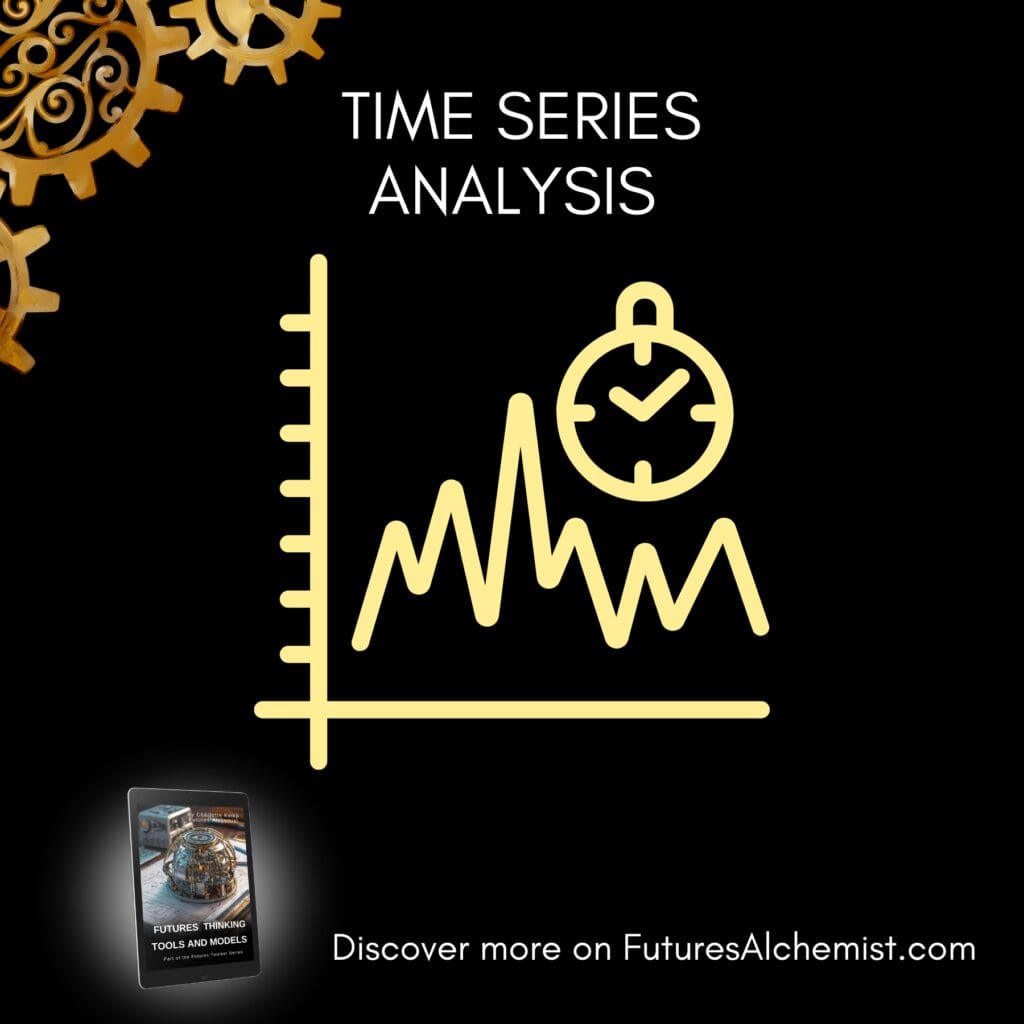
When visualised, Time Series Analysis often appears as a line graph, showing past data points and one or more forecast lines that extend into the future. Analysts interpret inflection points or deviations as potential early indicators of structural change.
Examples
A classic example is in climate science, where long-term records of global temperature, carbon dioxide levels, and sea levels are analysed to detect upward trends and cyclical fluctuations.
Another application can be seen in economic forecasting, such as analysing GDP growth or unemployment rates to predict recessions or expansions. During the COVID-19 pandemic, time series models were widely used to forecast infection rates and healthcare demand, guiding policy responses.
Some futurists use Time Series “deconstruction”, deliberately identifying points where historical continuity breaks to study disruptions rather than continuations.
It has been adapted for social media analysis, tracking the evolution of public sentiment over time to anticipate emerging cultural or political shifts.
In urban planning, Time Series Analysis has been applied to long-term data on land use, mobility, and energy consumption to simulate sustainable city futures.
How and when it is used
Time Series Analysis is typically used:
- When reliable longitudinal data is available and consistent.
- To quantify and visualise change over time, revealing growth patterns, peaks, or turning points.
- As a foundation for scenario planning, where extrapolated trends form one input among many.
- To test assumptions or validate qualitative foresight insights with empirical evidence.
In foresight work, it is most effective when combined with qualitative interpretation, for example, understanding why an observed trend is changing and what forces might accelerate or disrupt it.
Origin
The foundations of Time Series Analysis were laid in the early 20th century, particularly through the work of George Udny Yule and George Box & Gwilym Jenkins, who formalised the statistical principles underlying the method. The Box-Jenkins methodology (1970s) remains a cornerstone for modern time series forecasting.
While originally developed within econometrics and statistics, it has since become an integral method in multiple disciplines (economics, meteorology, epidemiology, and increasingly, strategic foresight) wherever understanding patterns of change over time is essential.
AI Use
Full Disclosure: this post was prepared with significant AI assistance. It’s part of a reference series, a straightforward summary of a model or concept rather than original commentary. Elsewhere on this site, the thinking, perspectives, and opinions are entirely my own, written without AI.
Other posts in this series