Introduction
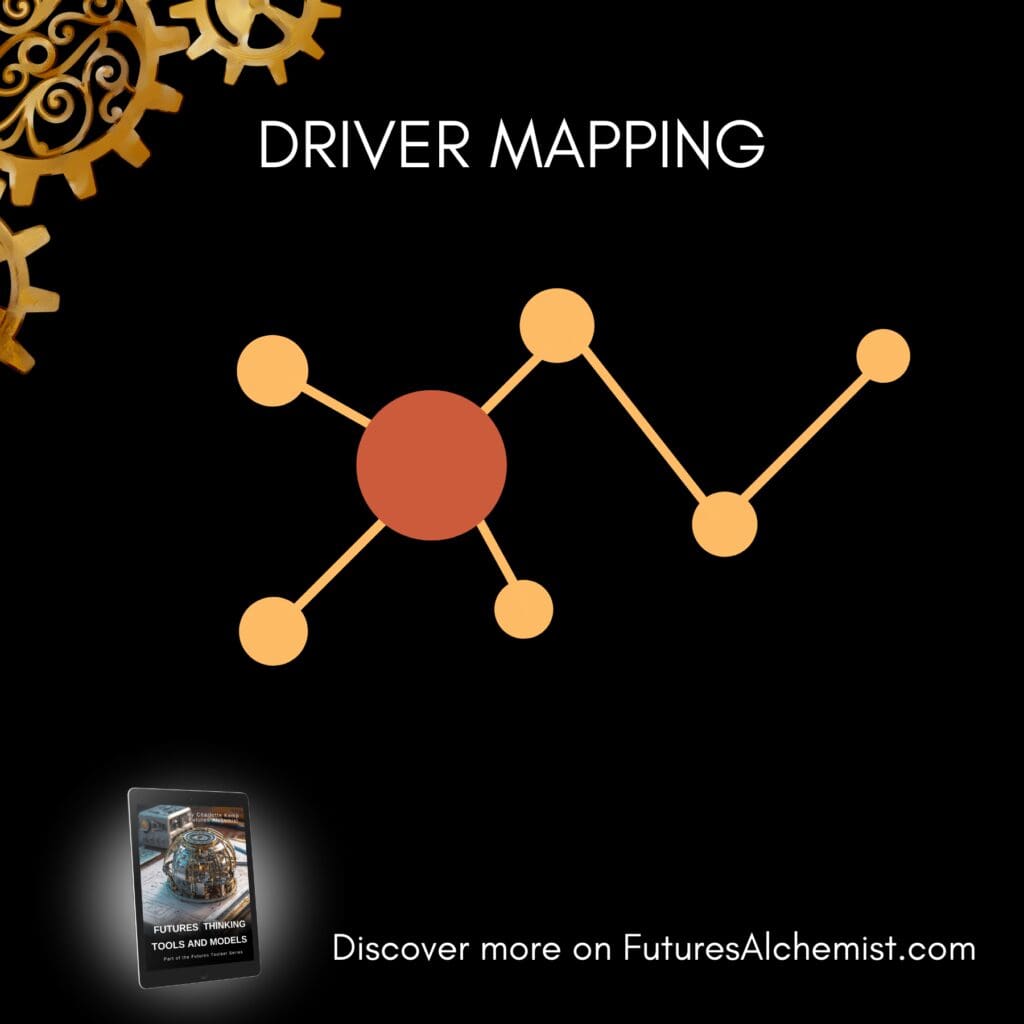
Driver Mapping is a futures tool used to identify, cluster, and structure the forces shaping change in a system, industry, or environment.It moves beyond listing trends to answer questions about which forces actually matter and how they are shaping possible futures.
A “driver” is not just a trend or signal. It is:
- A force with direction
- A pattern with momentum
- A dynamic that influences outcomes
Driver Mapping transforms scattered observations into coherent insights that help to provide a clearer view of what is shaping the future.
What it looks like when you use the tool
At first glance, Driver Mapping can look too simple, its just clusters of ideas on a page. But the thinking behind it is rigorous.
Typically, the process looks like this:
- Start with inputs
- Signals, trends, weak signals (often gathered via PESTLE or similar scanning tools)
- Cluster into themes
- Group related signals into emerging patterns
- Name the drivers
- Give each cluster a meaningful, directional label
(e.g. not “AI growth” but “Automation of cognitive work”)
- Give each cluster a meaningful, directional label
- Map relationships
- Identify:
- Reinforcing dynamics
- Tensions or contradictions
- Dependencies
- Identify:
- Prioritise
- Which drivers are:
- High impact?
- High uncertainty?
- Already locked in vs still evolving?
- Which drivers are:
- Visualise
- Often shown as:
- Clusters or ecosystems
- Influence maps
- Axes (for scenario building)
- Often shown as:
What emerges is a living map of forces.
An example
A good example is the rise of mobile money systems like M-Pesa.
If you applied Driver Mapping before its emergence in Kenya, you might have identified drivers such as:
- Limited access to traditional banking infrastructure (Economic / Structural)
- High mobile phone penetration (Technological)
- Trust in informal financial networks (Social)
- Regulatory flexibility in emerging markets (Political/Legal)
Individually, these look like PESTLE factors.
But when mapped as drivers, you begin to see:
- A convergence between technology and unmet need
- A tension between formal and informal financial systems
- A direction of travel toward decentralised financial access
The insight was not just that mobile technology was growing but that financial systems were being reconfigured around accessibility rather than institutional control. That is the level at which innovation becomes visible.
How and When it is Used
Driver Mapping is most useful when you have too much information and not enough clarity. It is also useful to move from observation to insight as you begin scenario planning, strategy development or innovation exploration.
It is typically used after environmental scanning (e.g. PESTLE) and before scenario building (to identify critical uncertainties) and strategic decision making (to test assumptions).
It is particularly valuable when the environment is complex and non-linear.
Scenario Planning Foundations
Driver Mapping is a core step in many scenario planning methodologies, including those pioneered by Royal Dutch Shell. Their teams used driver mapping to identify critical uncertainties that would later form the axes of scenarios.
Revealing Hidden Assumptions
Some organisations use Driver Mapping not just to map the future—but to surface what they believe to be true about the present.
Conflict and Policy Analysis
In geopolitical analysis, Driver Mapping has been used to understand conflict escalation dynamics, migration pressures and resource competition.
Creative Practice
Increasingly, designers and storytellers use Driver Mapping to build plausible worlds—especially in speculative fiction and design futures work.
Origin
Driver Mapping does not originate from a single named individual or moment. It emerged as part of the evolution of strategic foresight and scenario planning practices in the mid-to-late 20th century.
AI Use
Full Disclosure: this post was prepared with significant AI assistance. It’s part of a reference series, a straightforward summary of a model or concept rather than original commentary. Elsewhere on this site, the thinking, perspectives, and opinions are entirely my own, written without AI.
Other posts in this series