Introduction
Forecasting Models are systematic approaches used to predict future conditions or outcomes based on historical data, identified patterns, and assumptions about influencing factors. These models use mathematical, statistical, or computational techniques to estimate how current trends may evolve.
In strategic foresight, forecasting provides a quantitative perspective on possible futures. While it cannot predict the future with certainty, it offers a data-driven basis for anticipating plausible developments, often serving as a starting point before more exploratory techniques, such as scenarios or backcasting, are applied.
What it looks like when you use the tool
A forecasting model generally begins with a dataset (such as sales figures, demographic data, or technological uptake rates) and an identified variable of interest (what you wish to forecast). The practitioner selects a model type. For example:
- Linear or exponential projection, which extends existing trends forward.
- Econometric models, linking multiple variables such as income, population, and demand.
- System dynamics models, which simulate feedback loops and interactions.
- Machine learning or AI-based models, which detect complex, non-linear relationships in large datasets.
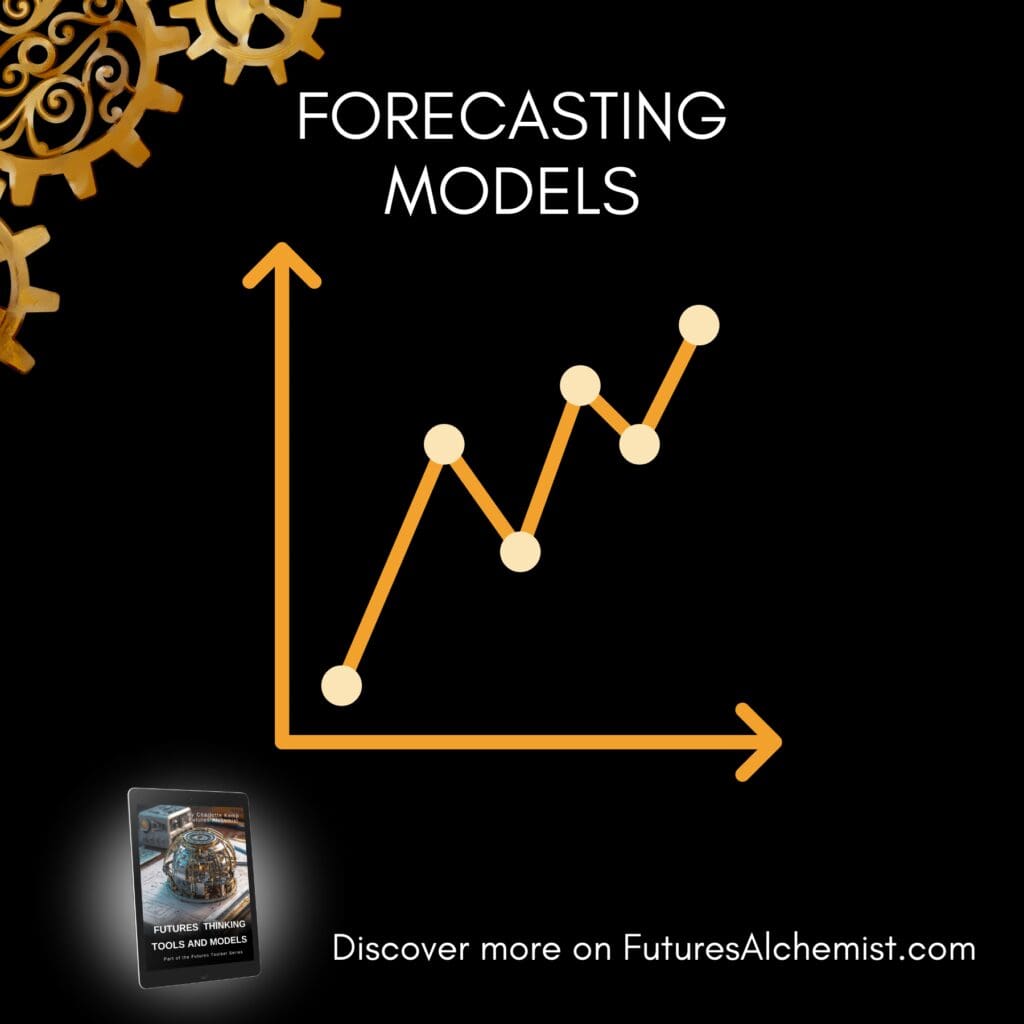
The output is usually a graph or chart displaying the model’s projections, often with confidence intervals to indicate uncertainty.
Examples
A well-known example is the Club of Rome’s “Limits to Growth” (1972) study, which used computer-based system dynamics forecasting models to simulate interactions between population growth, industrial output, pollution, and natural resources. The results highlighted the potential for ecological overshoot — sparking global debate on sustainability.
In the private sector, companies use demand forecasting models to anticipate sales and inventory needs. Governments apply macroeconomic forecasting to plan budgets or assess the impact of policy changes.
Some futurists have experimented with “forecasting the unforecastable”, using probabilistic models to estimate the likelihood of wild cards or black swan events.
In cultural foresight, trend data and social indicators are modelled to forecast shifts in values and lifestyles, rather than just economic outcomes.
Hybrid human–AI forecasting systems are increasingly common, where algorithms generate multiple futures and human experts assess their plausibility or ethical implications.
Forecasting models have even been applied in sports analytics, pandemic preparedness, and space exploration, illustrating their versatility across disciplines.
How and when it is used
Forecasting models are typically used when:
- Reliable quantitative data is available for analysis.
- Organisations need short- to medium-term projections to inform decisions.
- There is a need to test assumptions or compare scenarios under varying conditions.
- Policymakers or strategists require evidence-based foresight to support planning.
In foresight practice, forecasting is often used in combination with qualitative tools, such as Delphi, scenario planning, or Causal Layered Analysis, to balance the precision of data with the interpretive richness of human insight.
Origin
Forecasting as a formal discipline emerged during the mid-20th century, shaped by the rise of operations research and systems analysis during and after the Second World War. Early pioneers such as J. W. Forrester, Herman Kahn, and Theodore Gordon contributed significantly to developing computational forecasting models for military, economic, and technological planning.
The practice has since evolved into diverse subfields (technological forecasting, economic forecasting, and quantitative futures analysis) all seeking to combine empirical evidence with strategic insight.
Other posts in this series